The visual changes are slight, but I'm doing so much surfing from my phone these days that I decided to rework Brain Squeezings' Blogger template (i.e., its HTML page layout) to be more mobile-browser friendly.
Of course, it still looks like garbage in Pocket Internet Explorer's "Default" mode, but if you use "One Column" mode the site is very clean indeed.
Everyone please hit Brain Squeezings with every OS (Windows, Mac, Linux, Windows Mobile, PalmOS), and every browser (IE, Mozilla, Safari, Firefox, Opera, Pocket IE, Blazer) and let me know if anything broke!
-Rich
Wednesday, July 05, 2006

Saturday, June 17, 2006
Text-Only Test
This is a text-only Squeezings entry, testing how Blogger will handle it for formatting and the like.
I'm thinking about using Blogger Mobile for my all-text entries, and Flickr for my photoblogging. When you upload photos to Blogspot they seem to vanish into some sort of Google storage limbo. That, plus I <i>like</i> Flickr. :-)
-Rich
[Edit: Blogger Mobile escape-encoded my attempts to italicize "like" above, and the paragraphs automagically skip a line under themselves rather than retaining my line breaks. Verrry interesting.]
Sepia Sample
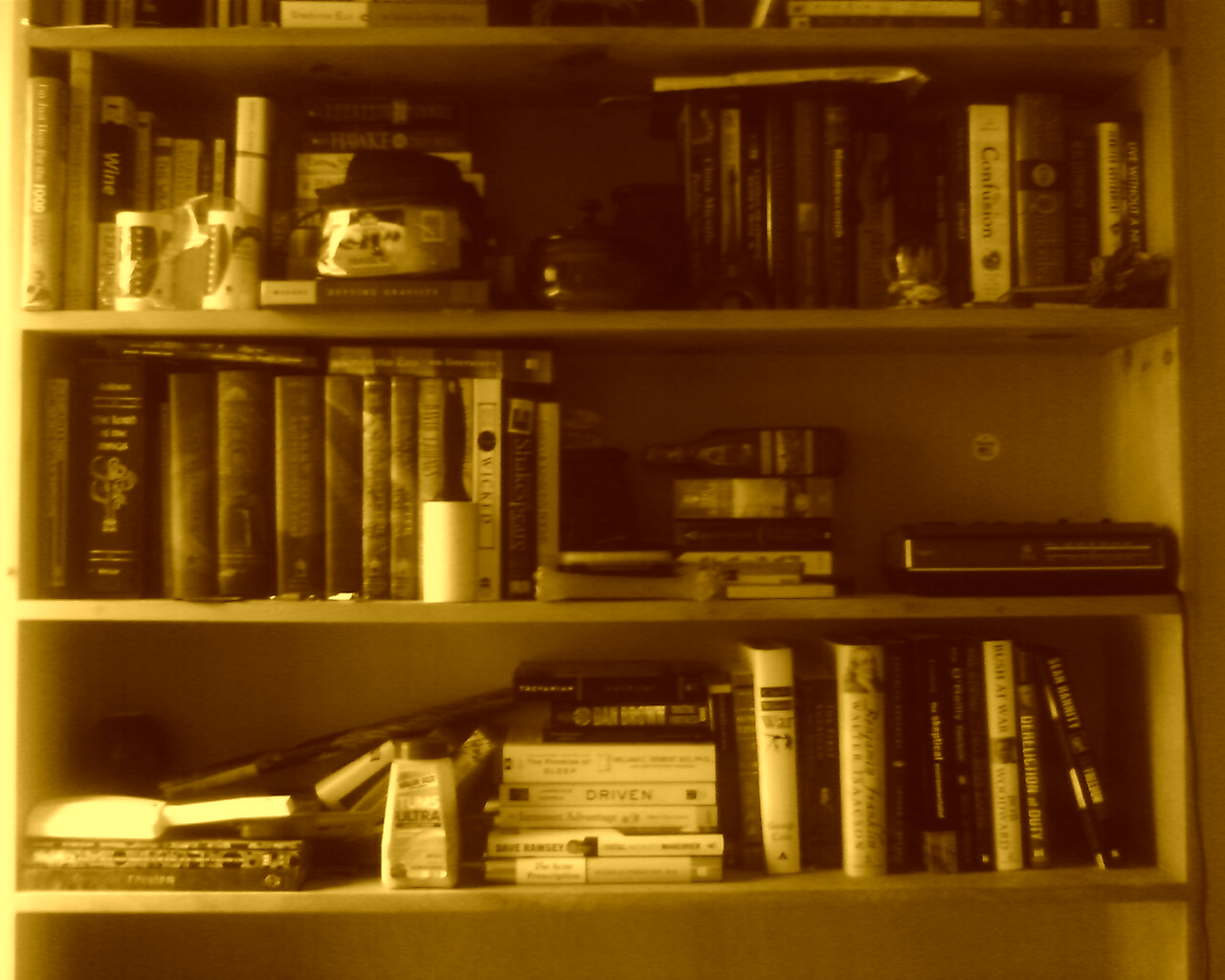
This is a sepia-toned snapshot of a cluttered bookcase in my bedroom here at Squeezings Central. This is a test post, verifying that my Blogger Mobile capability is working.
-Rich
Thursday, June 15, 2006
State of the Windows Mobile Art
 I have enjoyed my first month with my Cingular 8125 greatly. Sadly, though, the device, like so much in life, isn't perfect.
Actually, the device per se isn't the problem, though there are some aspects of the hardware that I'm not crazy about. The issue is Windows Mobile 5 (the spawn of Windows "Powered," and even further back, Windows CE).
Windows Mobile 5 (WM5) is actually a surprisingly capable operating system, coming as I do from both the Windows development world in my career and the Palm OS device world in my past PDA preferences. As I've raved before, it does very well as a phone (good call retention in low-signal areas), very well as a PDA (thousands of applications out there, PIM apps are good), very well as a mobile communicator (e-mail, SMS and MMS messaging), and very well as a mobile web-browsing platform.
History Lesson
That said, it's been a real adjustment moving back to a Windows-y PDA. I bought my first PDA, a PalmPilot Professional, back in 1998 (I still have it, and it still runs, given a pair of AAAs), and was hooked. I have an unbroken string of digital breadcrumbs back to data I entered into that first unit. I even bought a RAM upgrade and firmware update kit to keep it moving.
Back in 1999 or so, Microsoft finally entered the PDA game with a special version of Windows CE for the "Palm-sized PC," and I bought a Casio model that was actually a pretty sexy little beast (despite being slow and getting abysmal single-day battery life compared to months on a single pair of AAAs for the PalmPilots of the day). Sadly I cracked the Casio's screen when I leaned on a pool table with the unit in my pocket, and getting the unit fixed would have been as expensive as a new unit, so I dumped its data back into the old PalmPilot and soldiered on.
I've gone through a succession of Palm units since then (from the upgraded PalmPilot to a Palm IIIc, to a Palm m505, to a Tungsten T3, and most recently my Treo 650), primarily because I enjoyed the move back from the more cluttered Windows interface to the Zen of Palm, and no longer feeling like my device was underpowered for what it was being asked to do.
But that was then, and this is now. Palm, either through mismanagement or simply being outspent by competitors like Microsoft and RIM, has dwindled in market share to a shadow of its former self. The last version of the Palm OS was in testing for years, and rather than actually being released in a product, was sold to a Japanese company, and was last seen being broken down for parts for use in a Linux-based PDA OS.
On top of that, the convergence trend, after years of promises, has finally come to fruition, and a device that is only a PDA is no longer sufficient to compete: a device must be a cell phone first and a PDA second, and most likely also a communicator (meaning fluent with e-mail and other messaging) and a camera and multimedia machine.
The Treo 650 was, I predict, the last big Palm OS-based success, though the Treo 700p may well continue the love. The problem with the 700p is that there's also a Treo 700w, which runs (you guessed it) Windows Mobile 5. The use of WM5 in a Palm device, for me, was the deathknell of Palm as I've known it, and at best its capitulation to life as yet another Windows-Mobile-reliant hardware company. Time to switch back!
So Why was the Transition so Tricky?
Palm OS and Windows Mobile reflect radically different approaches to software design.
Palm OS, at its roots, is a single-tasking operating system. That means, absent some hackery, that its programs never have to worry about something running in the background and consuming resources that it might need. It has very little need to worry about programs "stepping on" one another while running, or doing any complex interleaving of execution context between programs doing different things simultaneously. Thus, Palm OS programs tended to be simpler and to store their contexts constantly (little need for the user to click a "Save" button) because they could never know when the user will exit your program to start another. In short, Palm apps tended to operate simply, like web pages. The best of them stored their contexts very completely, so that when you reentered that program, it looked like you never left, and felt like something more sophisticated than single-tasking was taking place.
Palm OS also allowed programs to execute "in place," meaning you didn't have to load programs from storage into RAM to execute them, you just ran them right where they were in the device's memory.
Windows Mobile is a multitasking operating system, and began its life as a cut-down version of the 800-lb. gorilla Microsoft Windows NT. There are many good things about being able to juggle several programs at once, but simplicity isn't among them. Another weakness of the multitasking approach is that having several programs running at once means they must all be consuming resources at the same time, which necessitates more powerful CPUs and more capacious storage. So Windows Mobile apps tend to be more elaborate in their OS demands and needs, and more like desktop applications than the web-page simplicity of Palm OS.
Speaking of storage, one nasty bit of legacy to Windows Mobile's genesis as a desktop OS is that storage is split into "storage memory" and "program memory." Yep, that means the old load-the-program-from-disk, run-it-in-RAM paradigm is alive and well in WM5. More complexity, and less flexibility for how memory is used on the device.
This would all be well and good if RAM and flash were free, and powerful CPUs consumed no battery power and emitted no heat. Sadly, we live in a world of limits, and Windows Mobile devices tend either to be underpowered, affordable and balky; or powerful, expensive and battery-starved.
The Cingular 8125, sad to say, falls into the former category. So why am I so happy with it?
Finding the Sweet Spot; Acceptance of High-Maintenance Tendencies
The good news is that the solution to Windows Mobile's woes on the Cingular 8125 is to flout its multitasking nature as much as possible: being almost powerful enough to multitask means that it's one hell of a single-tasker.
This flouting is tricky, because WM5's default behavior is to "minimize" programs that you choose to close, or render them invisible while keeping them running in the background. Minimizing like this means that the second startup of an application is blindingly fast (because it never left memory), but of course that means that it's very easy to wind up with lots of programs running in the background after a while, chewing resources and making the device sluggish. WM5 tries to handle this by truly terminating programs that haven't been used for a while when RAM gets scarce, but despite this being version 5 of Windows Mobile, it doesn't seem to be very good at keeping resources available. Throwing more CPU power and more memory at the problem can help, but for a guy like me who's always running different programs, it's like digging a hole in water.
Thankfully there are all sorts of third-party hacks out there that change the default behavior to terminating programs rather than minimizing them, and thus keeping as much of your device's mojo available for your use as possible.
There're also the little usage-patterns that you internalize when acclimating yourself to a new OS: the accretion of myriad "if it hurts when you do that, then don't do that" lessons that any software has to teach its users. It might be because I was a Palm user for so long, but Windows Mobile seems to have more bumps, quirks and rough spots than Palm OS does, even in its fifth iteration. Also, some of the programs (like ActiveSync--bad Microsoft!) tend to lock up. I typically have to soft-boot the device every other day or so.
A Man Who Knows Where His Towel Is
 So, my Cingular 8125 (dubbed "DontPanicBeep" and given a Hitchhiker's Guide wallpaper because it was the hoopy thing to do) is a high-maintenance, twitchy device that's prone to constipation if I don't use it properly, and occasionally goes foom.
But I don't mind, because for the most part I know where the landmines are, and the ability to do so many things so well with so few compromises in the hardware realm is worth it to me. Also, there's a lot of active development going on in the Windows realm, and it's my belief that a lot of the crashy/locky software issues will be fixed with time.
-Rich
Sunday, June 11, 2006
Will the Union Survive?
Tropical storm Alberto is currently menacing the Gulf coast of Florida. Fox News and other news outlets are keeping us all abreast of the developing crisis.
Winds of up to 35 miles per hour are forecast, as well as possibly as much as six inches of rain.
In related news, umbrella availability is dwindling across the state, and Sade and Barry White CDs are reportedly in dangerously short supply. The popularity of "Alberto" as a baby name is said to be skyrocketing, despite record sales of Trojan and Lifestyle prophylactics.
-Rich
Thursday, May 18, 2006
You Know, It's Really Very Simple.
Either immigration laws have meaning or they don't.
Either national borders have meaning or they don't.
Either American society has the self-confidence to preserve itself or it doesn't.
This has been a difficult few weeks to be a conservative Republican, because I'm a firm believer that we as Americans get the government we deserve. To be fair, Bush isn't the source of the problem, though he's far from helping with its solution. I knew W was iffy on illegal immigration when I voted for him, so his continuing to be so in the face of open revolt by his conservative base is hardly surprising, or even too disappointing, though his use of Vicente Fox to vet plans to move our own troops is worrying in the extreme.
What's boggling to me is the naked insouciance that (primarily Senate) Republicans have shown when presented with the clear opinion of their electorate: secure the border. Don't play patty-cake with how many illegals we're going to offer a decidedly amnestic "path to citizenship." Don't hide behind canards about whether it's feasible to deport 11 million illegals when depriving them of sympathetic employers would cause them to self-deport. Don't, for God's sake, extend Social Security benefits to illegals who attempt to qualify with fraudulent papers, or with time spent successfully avoiding the INS!
I'm very patient on the subject of immigration: at least one of my grandparents came over on a boat--I'm a relative newcomer in terms of genetic time in-country, but my ancestors obeyed the rules. One of America's strengths is that we assimilate and integrate new blood from all over. It's great: "Give me your tired, your poor, your huddled masses..." I'm down with that.
But (shame this even needs saying), there's a war on. We have a crater in downtown Manhattan, and newly-released footage of the attack on the Pentagon. United 93 is in theaters. We've seen a little bit more of the far end, now, of what happens when immigration laws aren't enforced. There're also the little matters of wage depression, an increasing tax burden on communities where great numbers of illegals live without paying income tax, chaos in border communities, and sightings of men in Mexican Army uniforms violating the border.
I'm going to put this as clearly as I can, elected officials: keep this up and you will pay with your jobs.
There's a real chance of a bloodletting this November. I just hope it's in the name of replacing incumbents with young bucks rather than Republicans simply staying home in droves...
"Speaker Pelosi." Brrr.
-Rich
Monday, May 08, 2006
Of Distribution Methods and Kings
Pity the synchronous entertainment industry: movies, television, newspapers, radio. No, really.
Take movies (please): it's getting harder and harder to make a consistent profit by hitting the targets that used to draw audiences into theaters. Mission: Impossible III is doing fairly lackluster business (though the sheer manic insanity of Tom Cruise might have affected its receipts a smidgen), there are braindead sequels of sequels getting made right and left, there's an increasingly barefaced preachiness and liberal bent to movies and to actors these days, guaranteeing alienation of a certain portion of films' potential audiences, and on top of that home theater equipment has moved into the mainstream (62.3 million hits on Google as of this writing).
I realized this afternoon that I haven't darkened the door of a movie theater since sometime in December, 2005 (Chronicles of Narnia: The Lion, the Witch and the Wardrobe). There simply hasn't been a cinematic offering since then that's been suitably compelling. I have, however, bought about a dozen DVDs (though none for a non-Pixar movie made in the past five years), subscribed to Netflix and watched hundreds of hours of TiVo- and/or Windows Media Center Edition-recorded TV in that time.
Then there's advertising-driven TV. Between (again) DVRs (TiVo, Windows Media Center Edition, etc.), Netflix (again) and the ability to download pretty much any TV show, movie, interesting video clip or photo from the internet, ads just aren't getting watched the way they used to be. There are more product placement deals being made, more technological hurdles being placed in front of TiVo and its cohorts by the more litigious TV content producers, but the technological trend is clear here.
Newspapers? Oy. I know I haven't subscribed to one of the dirty, bulky, fire hazards since the early 1990s. Internet, internet, internet, mobile internet, mobile internet, internet funnies! It's embarrassing how poorly physical newspapers serve my needs.
Radio: there are some bright points here (conservative talk radio, subscription satellite radio), but I know I find commercials amid my songs pretty well unbearable after nearly a year with XM. I download close to a half-dozen podcasts on a quasiweekly basis (only one of which is a recording of a radio show), and pretty much every talk radio show that values its audience publishes a podcast now. Again, asynchronous media is winning, and winning big.
Needing to show up or tune in at a specific time for media is so 1998.
Part of this is probably just me, and the fact that I have a beautiful woman to occupy my attention and my time, and that she and I are internet, DVD and timeshifting fools. But demographically I have to imagine that I'm not such an outlier. The coveted 18-to-35 male audience segment (which I exited only yesterday) is watching less synchronously-aired, mass-produced entertainment and occupying its time with more technologically tricksy stuff like TiVo-d media, iPods (containing everything from simple music to podcasts to video), videogames, and plain old websurfing.
Case in point: this past week I acquired a truly remarkable device: a Cingular 8125 Pocket PC, which is actually more of a smartphone than a full Pocket PC. I used to use a Palm Treo 650, and it did a decent job as a phone, camera, organizer and e-mail device, but a poor one as a web-surfing platform. Well, how bad can that be, you ask? It's a stinkin' phone! True, but now that I have a unit that excels at being a phone, a camera, an organizer and a web-surfing platform (I know, I scarcely believe it myself) I will never, ever, ever go back. Shoot, for the fun of it I streamed a Harry Potter trailer over the thing's cellular modem, and while it was hardly HDTV, it was impressive nonetheless. And it'll look positively Jurassic in a year.
Give me a flatscreen monitor and broadband connection for comfort, but the ability to get the latest news via RSS and WAP from a Panera Bread over coffee and croissants without even needing to lug a laptop around is where it's at, baby.
-Rich
Subscribe to:
Posts (Atom)